What Is an AI Suite? How Integrated AI Platforms Work in 2026
(Aidocsuite.com) – Artificial intelligence tools are no longer limited to single-purpose tasks. As workflows become more complex, users increasingly expect AI systems to manage entire projects rather than isolated steps. This shift has led to the rise of integrated, multi-tool AI platforms.
These platforms represent a new generation of AI solutions designed to unify multiple capabilities into one cohesive workspace.
What Is an AI Suite?
An AI suite is a unified ecosystem of multiple AI-powered tools designed to communicate, share data, and operate together within a single interface.
Unlike a standalone AI tool that performs only one specific function—such as generating text or creating an image—this type of platform supports end-to-end workflows. It can manage an entire project lifecycle, from initial drafting and data processing to final document, media, or file export, without requiring the user to leave the environment.
The 2026 Definition of an AI Suite
By 2026, the meaning of an AI suite has evolved beyond a simple bundle of features.
Today, it is best understood as an integrated workspace where specialized AI components collaborate to complete complex tasks inside one platform.
Instead of forcing users to manually move data between different tools, modern integrated systems coordinate these processes automatically. The result is a smoother, more efficient workflow with fewer interruptions.
AI Suite vs. Single AI Tool: Key Differences
Understanding the distinction between a single AI tool and a full AI platform is essential when choosing software for modern workflows.
| Feature | Single AI Tool | Integrated AI Platform (2026 Standard) |
|---|---|---|
| Focus | One specific task (e.g., transcription) | End-to-end project completion |
| Data Flow | Isolated, manual export/import | Seamless data sharing |
| User Interface | Unique per tool | Unified and consistent |
| Efficiency | High friction due to platform switching | Low friction through integration |
Single-purpose tools remain useful for narrow tasks, but integrated platforms are better suited for users managing complete workflows.
Why 2026 Is the “Year of the Suite”
In earlier years, many users experienced what is now commonly called tool fatigue. A typical workflow might involve one AI tool for writing, another for PDFs, and a third for generating voiceovers or media.
This fragmented approach introduced several challenges:
- Platform switching: Losing time moving files between tools
- Subscription overload: Paying for multiple “Pro” plans
- Security risks: Sharing data across multiple, unverified services
In 2026, integrated AI workspaces address these issues through connected workflows. Instead of managing each step manually, users define their intent, and the platform coordinates the tools internally to deliver a finished result.
Common Types of AI Suites
Modern AI suites are usually categorized by the problems they are designed to solve.
Productivity AI Suites
These platforms are built for document-heavy work and office environments. They typically include tools for writing, structured documents, spreadsheets, and presentations.
Core goal: Turning a prompt into a polished, professional document quickly.
Creative AI Suites
Creative-focused platforms support multi-modal content creation. Users can generate scripts, visuals, audio, and video within a single environment while maintaining consistency across formats.
Core goal: Producing complete creative assets without switching platforms.
Workflow and Business AI Suites
These solutions are commonly used in sales, marketing, and operations. They connect customer data with AI-driven automation such as email generation, reporting, and follow-ups.
Core goal: Automating business processes while keeping data centralized.
How AI Doc Suite Fits the Definition
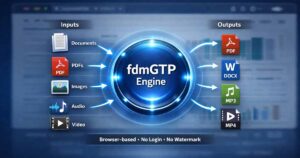
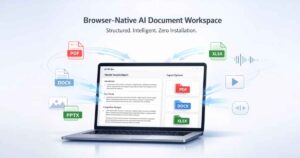
AI Doc Suite reflects the 2026 definition of an AI suite by focusing on document-centric, multi-modal workflows within a single browser-based platform.
Rather than offering one isolated AI function, it brings together:
- Text generation and document creation
- PDF handling and structured outputs
- Image processing and format conversion
- Audio generation through AI text-to-speech
All of these tools operate within the same interface, allowing data to move seamlessly between them.
Another defining characteristic is its emphasis on document automation. By using deterministic generation models, the platform prioritizes structured, reliable outputs instead of loosely generated text—an important factor for reports, tables, and professional documents.
The Benefits of Using an AI Suite
Moving from isolated tools to an integrated AI platform offers clear advantages:
- Speed: Projects that once took hours can now be completed in minutes
- Consistency: Visual style, structure, and tone remain uniform
- Lower costs: Consolidating tools often reduces software expenses
- Simplicity: One platform replaces multiple disconnected services
These benefits explain why AI suites are becoming the foundation of modern digital work.
Final Thoughts
In 2026, the key question is no longer whether AI is part of your workflow, but how fragmented your AI usage is.
A true AI suite is not just a convenience—it is an infrastructure choice. By moving away from isolated tools and toward integrated ecosystems, users gain efficiency, clarity, and control over their work.
Understanding what an AI suite is helps individuals and teams choose platforms built for modern, end-to-end workflows rather than disconnected tasks. Many modern productivity platforms, such as Google Workspace AI, demonstrate how integrated AI tools can streamline document creation, collaboration, and everyday workflows.