What Is an AI Document? How AI Is Transforming Document Creation
The Shift from Static Documents to Intelligent Documents
AI Documents have long been static files — created once, stored, and rarely updated unless necessary.
For years, this approach worked because digital workflows were simple and predictable. But today, the way people interact with information has changed. Work is faster, more dynamic, and increasingly dependent on automation.
Modern users expect documents to do more than just store content.
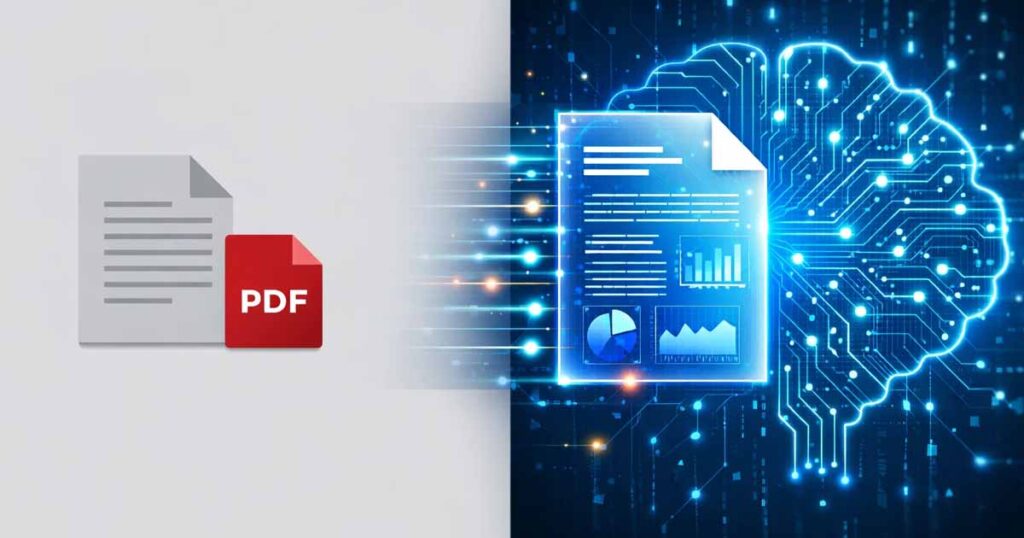
With the rise of artificial intelligence, traditional files are evolving into intelligent systems that can assist, analyze, and adapt. This transformation has introduced a new concept known as the AI Document.
An AI Document is not just something you read. It is something that understands information and helps you work with it more efficiently.
What Is an AI Document?
An AI Document is a digital document enhanced with artificial intelligence that can automatically generate, analyze, summarize, and organize content based on user intent.
Unlike traditional documents that simply display text, AI-powered documents actively process information. They can interpret language, detect structure, and respond intelligently to instructions.
These systems rely on technologies such as machine learning and natural language processing to understand context, relationships, and meaning within content.
In simple terms, an AI Document can read, understand, and assist — transforming a passive file into an interactive productivity tool.
How AI Documents Work
AI-driven documents follow a structured workflow that converts raw input into meaningful output.
Input
The system accepts various formats including PDFs, text files, scanned images, emails, and forms, making it flexible for different use cases.
Understanding
Artificial intelligence analyzes the content to identify language, structure, and intent. It can detect headings, paragraphs, tables, and important data points.
Processing
The content is then transformed based on user needs. This may include summarization, rewriting, classification, formatting, or extracting key insights.
Output
The final result is a clean, structured, and ready-to-use document that can be edited, exported, or reused.
Over time, these systems improve accuracy by learning from interactions, making results more relevant and precise.
AI Document vs Traditional Document
A traditional document is static, manual, and requires continuous human effort.
An AI Document is intelligent, adaptive, and capable of assisting in real time.
With traditional files, users must handle reading, editing, formatting, and organizing manually. This process is time-consuming and often inconsistent.
In contrast, intelligent documents automate repetitive tasks, reduce errors, and provide instant insights, making workflows faster and more efficient.
Key Benefits of AI Documents
Automation
AI-powered documents remove repetitive tasks such as formatting, rewriting, and summarizing content.
Efficiency
They significantly reduce the time required to create, edit, and review documents.
Accuracy
AI improves consistency in structure, grammar, and formatting, minimizing human error.
Scalability
Large volumes of content can be processed quickly without increasing workload, making these systems ideal for businesses and teams.
Common Use Cases of AI Documents
AI-driven documents are widely used across industries and everyday workflows.
They are commonly used to create and edit professional documents such as reports, invoices, and business content.
They help summarize long documents, research papers, and articles into clear insights.
They allow users to extract important information from complex files quickly.
They also assist in organizing and categorizing documents automatically.
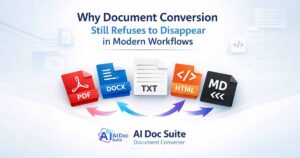
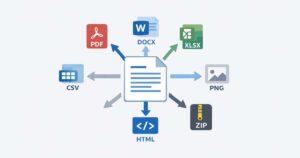
Additionally, these systems enable instant conversion of content into multiple formats, improving compatibility and usability.
Platforms like Free Document Maker and AI Doc Suite demonstrate how intelligent document systems can be used in a unified, browser-based environment without requiring installation or login.
Are AI Documents Secure?
Security depends on how the platform processes and handles data.
Many modern tools follow a privacy-first approach by using browser-based processing, minimal data storage, and user-controlled workflows.
This reduces the risk of data exposure and ensures better protection of sensitive information.
Choosing platforms that prioritize transparency and security is essential.
The Future of AI Documents
AI Documents are evolving rapidly from automation tools into intelligent collaborators.
In the future, documents will adapt to user behavior, update themselves automatically, and provide real-time assistance.
They will not just store information but actively participate in decision-making and workflow optimization.
This shift will fundamentally change how people and businesses interact with digital content.
Final Thoughts
An AI Document represents the next generation of digital files — intelligent, efficient, and adaptable.
As artificial intelligence continues to advance, these smart document systems will become a standard part of modern workflows.
If you want to experience this shift, platforms like Free Document Maker allow you to create structured, professional documents instantly using AI-powered tools directly in your browser. AI Doc Suite combines document generation, invoice tools, PDF utilities, and multimedia creation in a single browser-based workspace— helping users work faster without switching between multiple apps.
Tags: